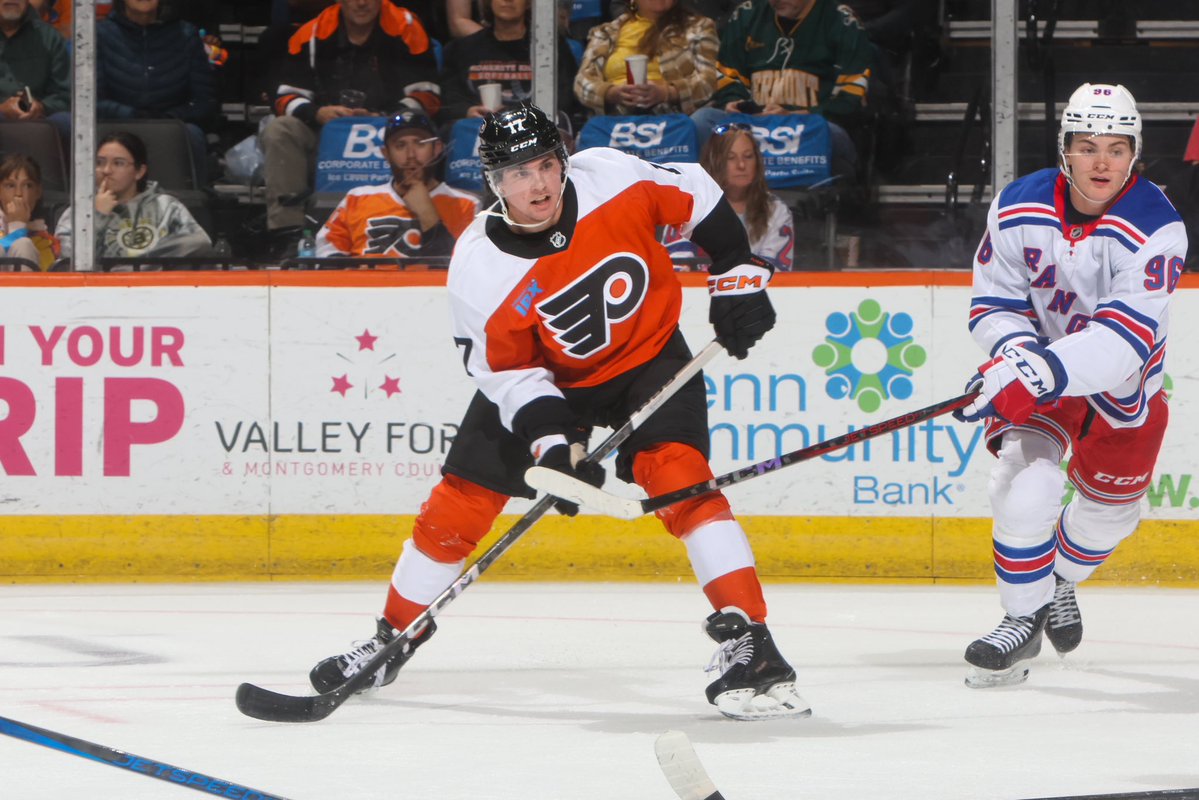
It’s not a foreign concept for a prospect with a playmaking archetype to earn their way into a top-six role. However, when you look at a franchise that, over a handful of seasons, needed help down the middle of the forward group, it’s easy to fall into a ‘thirst trap.’
What’s the thirst? Daniel Brière drafts a young playmaking center who can skate, acknowledges a two-way responsibility, and is marked for a potential role on the power play. What’s the trap? Inserting said prospect into the top six of the forward group before he has taken enough live NHL repetitions to acclimate his archetype to the faster-paced, highest difficulty of professional hockey.
Sean Couturier worked his way into his role. In his rookie season, 2011-2012, Couturier averaged 14:08TOI, competing on the third line. Maxime Talbot and Brière were ahead of him in the lineup during his rookie season. In his second season, 2012-2013, Couturier appeared in the middle six, shuffling with Brayden Schenn. In the 2013-2014 season, Couturier solidified his top-six role behind Claude Giroux once Brière joined the Montréal Canadiens and the Philadelphia Flyers traded Talbot to the Colorado Avalanche for Steve Downie.
Couturier is one of the longest tenured players to wear a Flyers sweater. His career in Philadelphia turned out stellar, and he wasn’t rushed into his current role. He’s the captain, a former Frank J. Selke Memorial Trophy winner, and he did it with a steady, patient approach as a team leader.
So, hold my beer while I die on the hill, claiming that prospects do not need to be immediately placed into their projected role.
Luchanko is Developing on the Fourth Line
The previously mentioned prospect I described, drafted by Brière, is Jett Luchanko. Luchanko found himself in a formidable situation heading into the 2025-2026 NHL Regular Season. He had to make the final cut with the Flyers, or he would return to the OHL with the Guelph Storm.
Suddenly, questions arose regarding his placement in the forward group. Luchanko is a forward marked for a top-six role in due time, but there’s a serious logjam down the middle of the lineup. Couturier is atop the forward group, Christian Dvorak and Trevor Zegras flex on the second line, Noah Cates is solidified on the third line, and Luchanko enters at the bottom, platooning with Rodrigo Ābols. In fact, Ābols started the 2025-2026 NHL Regular Season on the fourth line.
“Whatever it is they [Rick Tocchet and Daniel Brière] want me to do, I’ll be ready for.” – Jett Luchanko; 10/6/2025
Many wanted Luchanko in the opening night lineup, which is fair. However, Rick Tocchet chose a heavier lineup, featuring Ābols, Nicolas Deslauriers, and Garnet Hathaway on the fourth line to battle the most physical team from last season, the Florida Panthers.
Then, against the Carolina Hurricanes, and in the home opener versus the Panthers, Tocchet inserted Luchanko onto the fourth line with Hathaway and Nikita Grebenkin.
Luchanko: Flyers at Hurricanes
When Tocchet put Luchanko into the lineup against the Hurricanes, it was after Ābols went 6/8 (75%) at the faceoff dot. That’s one of the key strengths in his game, in addition to a sneaky scoring touch he displayed during the 2025 NHL Preseason. Tocchet wants Philadelphia to be a better puck possession team, but scoring depth is critical in taking the next step in building a playoff roster ‘brick by brick.’ In Florida, Ābols played 8:04TOI, creating high-danger scoring chances.
That context is important. Ābols did a lot of good things against the Panthers. Luchanko had his work cut out for him when Tocchet provided the opportunity against Carolina. He’s a better skater than Ābols, and defensively, Luchanko is a very aware two-way center who can create offense. Luchanko was tasked with demonstrating his abilities against the Hurricanes, who battled Florida in the Eastern Conference Finals during the 2025 NHL Postseason.
Comparably, in their first appearances of the 2025-2026 NHL Regular Season, Luchanko fared better with his linemates against Carolina. Individually, Ābols popped on the ice a little more in his lone performance against the Panthers. Luchanko went 3/6 (50%) at the faceoff dot, but remained pass-happy when he should’ve taken shots on goal.
One thing working against Luchanko is his commitment to look for the pass instead of recognizing when to take the shot. However, due to the success of the lineup against the Hurricanes, Tocchet kept Luchanko with Grebenkin and Hathaway in the home opener versus Florida.
Luchanko: Flyers vs. Panthers
There was growth in the home opener versus the Panthers. Still, Luchanko didn’t take a shot on goal, but he excelled in the finer details of his game. By definition, that’s development.
While Luchanko still remained mostly transparent in terms of his offense, he baited Florida into mistakes. He rushed Daniil Tarasov, alongside Grebenkin and Hathaway, creating a high-danger scoring chance. Tarasov made the save on Grebenkin, set up by Luchanko from under the hash marks. Tocchet wanted his forwards to get into the middle of the ice, and Luchanko began to do that with Grebenkin and Hathaway in the first period.
Additionally, Luchanko drew a minor penalty, putting Sam Bennett in the ‘sin bin’ for tripping. In terms of defense and puck possession, Luchanko added two blocked shots to his stat line while finishing 2/4 (50%) at the faceoff dot.
Unlocking More Offense
Time and place are key when inserting certain forwards on the fourth line. Tocchet liked a heavier lineup when visiting the Panthers, so he included Deslauriers, Ābols, and Hathaway on the fourth line. Then, against Carolina, a team that isn’t as physical, Tocchet tried Grebenkin, Luchanko, and Hathaway. When Florida came to town, it made sense to see what Grebenkin, Luchanko, and Hathaway could do in comparison to the heavier fourth line Tocchet already deployed.
Though I don’t foresee this happening, it would pique interest to see a fourth line consisting of Ābols, Luchanko, and Grebenkin. This version of a fourth line wouldn’t sacrifice any defense, forechecking, or puck possession from the faceoff dot. In fact, this formation of the Flyers’ fourth line accentuates scoring depth.
Understandably, some people will clamor for the enforcers and grinders like Hathaway and Deslauriers. Time and place are key, which I defend platooning Hathaway into the lineup for Ābols against more physical opponents.
However, when Luchanko and Ābols are winning 50% of their faceoff draws, or greater, it makes all the sense in the world to see how this fourth line operates, particularly with Grebenkin forechecking the way he does.
Ābols, like Dvorak and Zegras, is a center who can play left wing. Luchanko is being developed to play in the NHL exclusively as a center. Grebenkin can play right wing, too. This fourth line has much more scoring potential, and if Luchanko began to struggle at the faceoff dot, Tocchet could assign that particular duty to Ābols. This is just food for thought, but if Philadelphia is to focus deeper on developing Luchanko’s offense, it makes sense to put him with linemates who can help accentuate his playmaking and win more pucks.